American Single Malt Whiskey

May 12, 2024
By Rebecca Herman McBrayer

American single malt whiskey is a fast-growing category in the United States. According to a 2022 Forbes article, more than 100 distilleries were producing over 200 American single malt expressions. The numbers of distilleries in now over 130. This brief note explores some of the requirements for this spirit category.

American Single Malt Whiskey Commission (ASMWC)

The American Single Malt Whiskey Commission (ASMWC) was formed in 2016 to address the growing need for American-based producers to define the category—both domestically and internationally—in order to protect, educate, promote and ultimately grow it. The ASMWC has been instrumental in getting this spirit category an identity as well as proposed standards.

The ASMWC has a terrific Press Page if you have an interest in reading related articles.

American Single Malt Whiskey Requirements

July 29, 2022 – In response to requests and petitions, specifically from the ASMWC, the TTB proposed establishing a specific standard of identity for American single malt whisky. From the Federal Register, there was a notice of proposed rule making and the following summary:

“The Alcohol and Tobacco Tax and Trade Bureau (TTB) proposes to amend the regulations that set forth the standards of identity for distilled spirits to include “American single malt whisky” as a type of whisky that is a distinctive product of the United States.”

Under the proposal, to be labeled American single malt whisky, the product must be:

1) Distilled entirely at one U.S. distillery
2) Must be mashed, distilled, aged in the United States
3) Must be sourced from a fermented mash of 100% malted barley
4) Have a distillation proof of 160° or less
5) Stored in oak barrels not exceeding 700 liters. 

In addition, allowable coloring, flavoring, and blending materials would be permitted.    

I hope that this brief note brought clarification regarding American Single Malt Whiskey.
Rebecca

Overcoming Bourbon Burn

April 28, 2024
By Rebecca Herman McBrayer

Tasting a fine spirit like whiskey or bourbon is as much art as it’s science. That said, it also takes much time to become accustomed to it, especially after experiencing a burning sensation as you take your first sip. In the article, “Enjoying Bourbon Might Take Patience,” Wayne shared his personal story of how long it took him to be able to drink bourbon neat and truly enjoy it. For this Sunday Spirit Note, I share some reasons why whiskey/bourbon can burn your throat and tips on reducing such unpleasant experiences.

What is Whiskey Burn

Whiskey burn, a tingling sensation in the mouth and throat, is caused by ethanol activating Vanilloid Receptor-1 (VR1) nerve cells, which send distress signals to the brain, interpreting the drink as too hot and causing a burning sensation to prevent further consumption. The burn intensity depends on the whiskey’s alcohol content and temperature. Ethanol lowers the activation temperature of VR1 receptors, making them more sensitive to the heat of the whiskey. Similar to the reaction to capsaicin in spicy foods, VR1 receptors are activated at a lower temperature in the presence of ethanol, triggering the burning sensation. Whiskey burn is a protective mechanism to prevent tissue damage from consuming liquids that are too hot or potentially harmful.

Steps to Reduce the Burn of Bourbon Whiskey

There are multiple approaches that can be taken to reduce the burn of bourbon whiskey to help you enjoy it more. Over time, you can find the method that is best for you and you may also find that different options for different bourbons are most effective.

Add water: Dilute the whiskey with a few drops of water using a straw. Start with three to five drops and add more until you reach your desired dilution. Water can also release additional aromas and tastes by reducing the alcohol content.

– Add ice: Adding ice can neutralize the burn and prevent dehydration and a parched throat.

Chill the drink: Chilling the bottle or glass in the refrigerator for about 2 hours will soften its flavor; thus, reducing the burn and helping it go down more smoothly.

Use a straw: Drinking whiskey through a straw can help to bypass the back of the throat and reduce the burn.

Take small sips versus large swigs: Savor your drink with small sips instead of chugging it to reduce the burn. This also helps you to enjoy the flavors more. Have a glass of water on hand for drinking to quench your thirst so you will be more inclined to sip your bourbon slowly.

Hold the whiskey in your mouth: Allowing the bourbon to sit in your mouth for a few seconds before swallowing helps the flavors to dissipate and reduces the burn. This is especially important on the first few sips as it can help to numb the tongue.

Roll it around on your tongue: This has a similar effect as holding it in your mouth. By gently rolling the bourbon around on your tongue before swallowing, it allows the flavors to develop and reduce the burn.

– Drink then exhale: Take a deep breath in, exhale a bit, sip the whiskey, and then exhale the rest of the air. This flushes out alcohol vapors and reduces the burning sensation.

Add a mixer: Mixing whiskey with a non-alcoholic beverage, such as soda or juice, can reduce the alcohol concentration and make it more palatable.

Bourbon whiskey often causes a burning sensation due to its high alcohol content, but various methods can mitigate this. If you tour a distillery in Kentucky, it is often described as the “Kentucky Hug.’ Experimenting with chilling techniques, dilution of alcohol, tasting approaches, and even breathing techniques, can reduce the burn while preserving the flavor.

Remember, when ordering bourbon whiskey in a bar, it can be consumed “straight,” which involves cooling it and straining it over ice, or “neat,” which means serving it at room temperature without any additives. While some prefer the pure flavors of bourbon neat, others suggest sipping it slowly to fully appreciate its nuances. Ultimately, the best way to enjoy whiskey is subjective and it certainly depends on personal preferences.

In the words of Jim Beam’s Master Distiller, Fred Noe, and his father (Booker Noe) before him, “Drink it any damn way you please.”

Enjoy Your Bourbon Journey – And Always Drink Responsibly
Rebecca


Bourbon Yeast Flavors

04/21/24
By Rebecca Herman McBrayer

As discussed in Bourbon Whiskey, there are some common flavors that are noted when tasting bourbon. We recently discussed the contribution of grains to the taste of bourbon. For this Sunday Spirit Note, the focus is on the impact of the yeast strain, used in fermentation, to the aroma and taste of bourbon.

Yeast and Aroma – Esters

During the fermentation stage of making spirits, yeast is added to the mash and it begins converting the sugars in the mash to alcohol and carbon dioxide. The aromatic compounds that are produced by yeast as a byproduct of fermentation are called easters. These esters vary among yeast strains, for example, some yeasts produce a fruity scent, while others leave a bourbon with a hint of spice, herbs, or flowers.

Yeast also plays a vital role in shaping the flavor profile of bourbon. As yeast acts to convert sugars into alcohol, it creates flavor compounds known as congeners. Each yeast strain produces different congeners and at varying levels. These congeners can be fruity, floral, or strong aromatic flavors. This is similar to how grape varieties influence wine. This diversity in yeast strains and their congener production accounts for the wide range of flavor experiences found in different bourbons. Yeast, therefore, holds significant importance in determining the distinctive taste of each bourbon.

Distillery Proprietary Yeast Strains

Historically, distillers have been known to carry their prized yeast in a Yeast Jug. Some would never let it out of their sight. They wanted to protect and nurture it so their signature strain would be ready for fermentation. While this is often associated with moonshiners, there is a Yeast Jug on display at Jim Beam.

Proprietary yeast strains play a crucial role in shaping the distinctive individuality of bourbon brands. Many distilleries possess proprietary yeast strains that heavily influence their bourbon’s flavor profile, keeping their composition a closely guarded secret.

The preservation of yeast strains ensures the continuation of a distillery’s signature style, as seen in the case of Wild Turkey, which has used the same yeast strain for over 60 years, resulting in a renowned “boldness.” Jim Beam’s yeast has been used in their bourbon-making process since Prohibition ended, ensuring a distinctive and consistent flavor profile.

Distillery Yeast Examples

As mentioned above, bourbon distilleries use proprietary yeast strains to create unique flavors and aromas in their products. Bellow are a few examples.

– Old Forester uses a proprietary yeast strain called 1B, which gives the bourbon a fruity forward taste, especially banana.

– Wild Turkey has used the same yeast strain for over 60 years, and many say it gives the bourbon a “boldness” that’s “musty, punchy, nutty and rich.”

– Jim Beam’s yeast is known for giving bourbon a “foxy” taste, which is different from other producers. It’s a closely guarded family secret that has been used since Prohibition ended in 1933.

– Woodford Reserve Kentucky Straight Bourbon Whiskey uses a proprietary yeast strain called 72B, which was developed specifically for the brand and contributes to its distinctive flavor profile with notes of vanilla, nuts, oak, cinnamon, nutmeg, caramel, spice, leather, tobacco leaf, and maple.

– Maker’s Mark uses a strain of yeast that the Samuels family has used for generations, and the yeast gives the bourbon a mouthwatering, fruity taste.

– Heaven Hill Distillery’s yeast strain has a robust complexity that includes sweet, cocoa, oak, grains, fruits, and spices. Some say that yeast can create floral, nutty, or extra fruity flavors.

Four Roses Bourbon produces a wide range of flavors by blending various yeast strains and mash bills. The use two mash bills – Mash Bill B emphasizes rye, while Mash Bill E prioritizes corn. Five yeast strains impart unique characteristics. These elements are combined to create ten distinct recipes as indicated on the table below.

Mash Bill B – 60% Corn, 35% Rye, 5% BarleyMash Bill E – 75% Corn, 20% Rye, 5% Barley
Yeast V – delicate fruit1 – OBSV – delicate fruit and rye6 – OESV – delicate fruit and caramel
Yeast K – slight spice2 – OBSK – rye and baking spice7 – OESK – baking spice
Yeast O – rich fruit3 – OBSO – rich fruit8 – OESO – rich fruit and vanilla
Yeast Q – floral essence4 – OBSQ – rye and light floral character
9 – OESQ – delicate grains and floral character
Yeast F – herbal notes5 – OBSF – delicate rye and mint10 – OESF – light grain and mint
The four-character recipe: O for distilled at Four Roses, B or E for the Mash Bill, S for Straight Whiskey, and the final letter (V, K, O, Q, or F) for the yeast strain.

When you taste bourbon and pick up various flavors, connect to its source and consider the contributions made by the specific yeast strain used by the distiller(y).

There are many more sources of bourbon flavors. As noted in other Sunday Spirit Notes, this includes, grain selection, fermentation process, barrel selection and preparation (level of toast and char), entry proof into the barrel, the storage environment, and even decisions made for bottling. With so many variables, it is no wonder that there is such a wide range of bourbon flavors and why five people tasting from the same bottle may pick up different notes and have varied preferences.

Happy Tasting!
Rebecca


Canadian Whisky

04/14/24
By Rebecca Herman McBrayer

Canada produces more than 21 million cases of whisky each year. Popular brands in the US include Crown Royal, Black Velvet, and Canadian Club. This brief Spirit Note discusses Canadian Whisky requirements, mash bill, and production approaches. The taste profile and Canadian Whisky availability in the US is also reviewed.

Canadian Whisky Requirements

Production: It must be mashed, distilled, and aged entirely in Canada.

Grain: Despite its historical association with rye, Canadian whisky can be made from various cereal grains.

Aging: Whiskies must spend a minimum of three years in wooden barrels of 700 liters or less.

Alcohol content: They must contain at least 40% ABV.

Flavoring: Can contain caramel coloring or flavoring.

9.09% Rule: The 9.09% rule allows Canadian whisky producers to enhance their blends with up to 9.09% of non-whisky ingredients, provided they have been aged for two years in wood. This rule, stemming from a US tax incentive, has rarely been utilized. Despite criticism from competitors, most Canadian whisky remains pure, with the occasional addition of sherry instead of American spirits.

Unlike American bourbons, Canadian whiskies do not typically use a mash bill containing multiple grains, but they are often a blend of lighter triple-distilled grain spirits and a smaller proportion of richer “flavoring” spirits. The amount of rye used in the blend influences the spiciness of the whisky, with more rye resulting in more pronounced spice notes.

Canadian whiskies are usually made by blending aged whiskies that are produced from individually fermented and distilled grains. These various grains, such as corn, rye, and barley, impart unique flavors and characteristics to the final blend.

Two Common Production Streams

Canadian whisky production utilizes two distinct streams: base whiskey, distilled to high alcohol and matured in used barrels to highlight wood-derived flavors, and flavoring whiskey, distilled to low alcohol and matured in new or new and used barrels to emphasize grain-derived congeners. While some distilleries produce only one base whiskey, others create multiple variations. The combination of these streams creates the characteristic elegance of Canadian whisky.

Canadian whisky is characterized by its distinct flavors. It is typically lighter and sweeter than other whiskies, with notes of vanilla, cinnamon, nut, and fruit. These flavors are often complemented by hints of caramel or butterscotch, as well as spices. The higher distillation proofs and aging in used oak barrels contribute to its unique taste profile.

The top eight Canadian whisky producers (and their parent companies), which account for over 95% of production, are:

– Alberta Distillers/Beam Suntory
– Black Velvet/Heaven Hill
– Gimli & Valleyfield/Diageo
– Hiram Walker/Pernod Ricard
– Kittling Ridge/Campari Group
– Canadian Mist/Sazerac
– Highwood
– Valleyfield

Canada has experienced a surge in craft whisky production over the last decade, with the number of distilleries reaching nearly 300. These distilleries are experimenting with innovative styles that demonstrate the versatility and potential of Canadian whisky, offering a wider range of flavors and experiences for enthusiasts.

Canadian whisky, particularly Crown Royal, enjoys significant popularity in the US, with other brands such as Black Velvet, and Canadian Club.

Additional Canadian offerings include Confederation Oak Reserve, Pendleton, Caribou Crossing, Rare Perfection, and Alberta.

Crown Royal flavored profiles, such as apple, vanilla, and peach as well as limited edition salted caramel and blackberry are also very popular.

Many people might not realize that Fireball Cinnamon Whisky, owned by the Sazerac Company, is made with Canadian whisky.

I hope that this brief note brought clarification regarding Canadian Whisky.
Rebecca


Bourbon Grain Flavors

04/07/24
By Rebecca Herman McBrayer

As discussed in Bourbon Whiskey, there are some common tastes that are noted when tasting bourbon. For this Sunday Spirit Note, the focus is on contribution of the grains, the foundation of the spirit, to the taste of bourbon.

Corn

As part of the requirements, bourbon must be made from at least 51% corn. Corn imparts a sweet flavor profile to bourbon and contributes to bourbon’s rich body and creamy texture. Some of the tasting notes derived from corn could include:

– Vanilla
– Caramel
– Butterscotch
– Honey
– Brown butter
– Toffee
– Toasted marshmallows

Rye

Rye is a common grain used by many distillers. In general, it assists in adding a spicy flavor profile to the spirit. The percentage of rye used in the mash will influence the flavor produced. Rye bourbons are also described as aggressive and have a savory balance to the typically sweeter, corn-based elements of the bourbon. Some of the tasting notes derived from rye might include:

– Black pepper
– White pepper
– Rye bread
– Mint
– Herbal
– Anise

Wheat

In general, using wheat in the primary mashbill is not common. Some distillers create a wheated bourbon and omit the use of rye.  Others include wheat and rye to make a four-grain bourbon. The combinations are endless. In general, wheat doesn’t have a lot of flavors but can mellow the spirit and add a bread-like taste to it. Some of the tasting notes influenced from wheat use might include:

– Vanilla
– Honey
– Caramel
– Toasted oak
– Toffee
– Fruity
– Vanilla ice cream
– Bananas foster

Malted Barley

Nearly all bourbon has some percentage of malted barley because it assists with the fermentation process. Malting is a drying process that causes barley to produce enzymes that convert long-chain carbohydrates into simpler sugars that can be fermented by yeast into alcohol. In addition to that critical contribution, malted barley can give bourbon a warm, nutty, and smoky profile with hints of:

– Toast
– Toffee
– Cereal
– Cocoa

When you next taste bourbon and pick up various flavors, connect to its source and consider the contributions made by the various grains used in the mashbill.

There are many more sources of bourbon flavors. Most often, this includes, yeast selection, fermentation process, barrel selection and preparation (level of toast and char), entry proof into the barrel, the storage environment, and even decisions made for bottling. With so many variables, it is no wonder that there is such a wide range of bourbon flavors and why five people tasting from the same bottle may pick up different notes.

Happy Tasting!
Rebecca


Tennessee Whiskey

03/31/24
By Rebecca Herman McBrayer

Many patrons walk into a bar and order a whiskey or a bourbon and might not understand the nuances that could make them different or the requirements for specific labeling. Instead, people are often brand loyal, try drinks that are on special, or perhaps order what friends and family members have always had around.

The popular song by Chris Stapleton – “Tennessee Whiskey” can get people singing together and raising a glass or two. How many people that know and love that song understand the requirements for a spirit to be labeled a Tennessee Whiskey? Let’s review the basics and perhaps it could help you win a local trivia contest one night!

Tennessee Whiskey starts with the same requirements as Bourbon.  It must be made with a mashbill that contains at least 51% corn. It must be distilled at a maximum of 160 proof (80% ABV).  It then must be placed into a new, charred oak container at a maximum of 125 proof (62.5% ABV). In addition, it must be free from added substances (except water) and bottled at a minimum of 80 proof (40% ABV).

There are two additional requirements that make it unique. First, it must be made in the state of Tennessee.  Second, it must be filtered through maple charcoal prior to aging. The charcoal filtering is often accomplished using the Lincoln County Process.

The traditional method of producing Tennessee Whiskey involves what is known as the Lincoln County Process or Charcoal Mellowing. The process is named after Lincoln County, Tennessee, where the Jack Daniel’s distillery was located when it was established.

The process involves filtering or steeping the freshly distilled spirit in charcoal chips before aging it in the new charred oak container. The charcoal acts as a natural filter, absorbing certain compounds from the spirit, which modifies the spirit’s character and has a significant influence on the flavor profile of the mature whiskey. The process is required by state law, but there is leeway for customization. 

The process can take 3–5 days, with newly-distilled whiskey trickling drop by drop through ten feet of densely packed sugar maple charcoal. The resulting charcoal is then run through a grinder to reduce it to consistent bean-size pellets, which are then packed into 10-foot vats. 

On the U.S. Federal level, the only recognized legislation regarding the Tennessee label is the North American Free Trade Agreement (NAFTA), which states that Tennessee whiskey is “a straight Bourbon Whiskey authorized to be produced only in the State of Tennessee.” This definition is also recognized in Canadian law, which states that Tennessee whiskey must be “a straight Bourbon Whiskey produced in the State of Tennessee.” None of these regulations requires the use of the Lincoln County filtering process (or any other filtering process).

The origin of the charcoal filtering requirements is directly connected to the state of Tennessee. On May 13, 2013, the Tennessee Governor, Bill Haslam, signed House Bill 1084, requiring maple charcoal filtering to be used for products produced in the state labeling themselves as “Tennessee whiskey” and including the existing requirements for bourbon.  Thus, this Tennessee law effectively gives a firm definition to Tennessee whiskey.

Tennessee whiskey is often described as a lighter version of bourbon. It has notes of toasted oak, caramel, and vanilla, as well as a hint of charcoal or burnt wood. The charcoal-filtering process mellows out the flavor, making it less bold and harsh. Its finish is often limited. The Lincoln County Process gives the whiskey more of a smoky flavor and it has less of a creamy mouthfeel.

While the number of Tennessee Whiskeys is growing, there are some brands that are more well-known and typically readily available.

Jack Daniels is the most popular Tennessee whiskey in the US, and the most recognizable. Ordering a Jack & Coke is something frequently heard in bars. Jack Daniels is owned by Kentucky-based Brown-Forman, who also owns such brands as Old Forester and Woodford Reserve.

George Dickel is also well-known and was established in 1878. Dickel is owned by London-based Diageo, who owns such brands as Bulleit and Crown Royal.

Chattanooga Whiskey has gained popularity and one of the fastest growing Tennessee brands is Uncle Nearest. The current list of distilleries on the Tennessee Whiskey Trail is 26!

Bottled in Bond

03/24/24
By Rebecca Herman McBrayer

If you drink whiskey, you have likely seen: Bottled in Bond, Bottled-in-Bond, or BIB on some bottles. In case you have ever wondered what this means or requires, we will dive into it a bit in this Sunday Spirit Note.

The Bottled in Bond Act of 1897 was a groundbreaking consumer protection law addressing widespread whiskey adulteration in the 19th century. Championed by Colonel Edmund Haynes Taylor Jr., the act standardized the designation of high-quality spirits, designated as “bottled-in-bond” if they met specific requirements.

Why Bottled in Bond was Needed – Rectifiers

In his book, Kentucky Bourbon Whiskey: An American Heritage, Michal Veach explains that rectifiers were individuals who purchased cheap whiskey and refined it to make it more palatable and appealing to the mass market. Initially, they relied on unaged spirits from farmer distillers, but eventually, they began using various additives to enhance the flavor and appearance of their product. These additives included burnt sugar for sweetness and color, prune and cherry juice for color and flavor, and even unusual ingredients such as creosote (a wood preservative) and cochineal (a red dye made from crushed insects) to achieve the desired characteristics. The resulting product, while not an authentic bourbon, was affordable, sweet, and easy to produce in a matter of hours rather than years, making it a popular choice for consumers seeking an affordable and flavorful whiskey option.

The Specific Requirements to be Bottled in Bond

The very first consumer protection passed by Congress was the Bottled in Bond Act of 1897 was a response to the widespread adulteration of American whiskey in the late 1800s. The act established a standardized designation for spirits based on quality and made the federal government the guarantor of a spirit’s authenticity. The act also provided a tax incentive for distilleries that ensured their spirits met specific requirements.

The act allows distillers to label aged spirits, mostly bourbon and rye, as bottled-in-bond if the product meets the following criteria:

  • The spirit must be produced in a single distillation season by a single distillery.
  • The spirit must mature in a U.S. bonded warehouse for a minimum of four years.
  • The aged spirit must be bottled at 50% ABV (100 proof).

The act also helps ensure proper accounting and the collection of tax that is due. The Bottled in Bond Act is one of the earliest examples of a consumer protection law. President Grover Cleveland signed the act into effect in 1897.

What it Means to Consumers Today

According to a publication by the American Distilling Institute, What the Bottled in Bond Act of 1897 Means Today, the “Bottled in Bond” label remains relevant due to its guarantee of authenticity and quality.  Consumers continue to rely on the label as a symbol of trustworthiness in an era where undisclosed sourcing is prevalent. Despite changes in regulations and the absence of government stamps, distillers still use the term for marketing purposes. The global threat of alcohol contamination underscores the continued need for safeguards like the Bottled in Bond label. International regulations require imported spirits to meet the same standards as domestic products, further enhancing the label’s credibility.

Ultimately, it ensures authenticity and quality, especially in an era of unknown sourcing.  Despite not being a requirement, the label has become a symbol of trust and quality for whiskey enthusiasts. It also protects against alcohol contamination.


Irish Whiskey

03/10/24
By Rebecca Herman McBrayer

Irish whiskey is made from a high grain mash of barley, wheat, and corn. The exact quantities of each grain depend on the type of whiskey. The most common primary grain is barley.  The barley and be malted, un-malted, or a combination of each.

Basic Requirements for Irish Whiskey

The Irish Whiskey Act of 1980 defines the basic requirements for Irish whiskey. The act protects Irish whiskey by statute law and provides regulations and labeling for the spirit. The requirements include:
– Produced and aged in Ireland.
– Made from cereal grains that are fermented with yeast.
– Distilled no higher than 94.8% ABV (proof of 189.6).
– Aged in wooden casks for a minimum of three years.
– Free of added substances with the exception of water and caramel coloring.
– Bottled at a minimum ABV of 40% (proof of 80).

Types of Irish Whiskey

Malt Irish Whiskey: Made in pot stills at one distillery with only water and malted barley. Example – Bushmills 10-year-old, 80 proof.

Pot Still Irish Whiskey: Denotes it was made from malted and un-malted barley and distilled only in a pot still. Example – Redbreast 12-year-old, 80 proof.

Grain Irish Whiskey: It was made from un-malted grains in a column still. Example – Teeling Single Grain, 92 proof.

Blended Irish Whiskey: Indicates the whiskey is a blend from both column and pot stills. Example – Jameson, 80 proof.

Irish Whiskey Taste Profile

Irish Whiskey has a distinct flavor profile that can be described as light, fruity, and floral, with common notes of cereal grains, vanilla, caramel, and oak.

Single Malt Irish Whiskey often has a fruity profile with notes of apple, pear, and citrus, and a subtle nuttiness and hint of vanilla. Those made of 100% malted barley-based blends are smooth, sweet, and malty. 

Blended Irish Whiskey is generally smooth, with notes of caramel, vanilla, light spice, and a hint of oak. 

Like other spirits, the flavor profile can depend on where it was produced, how it was aged, and brand desires for its signature taste profile.


With St. Patrick’s Day around the corner, many will be sipping and toasting with an Irish Whiskey. I hope that this basic overview will help you to enjoy it all the more!

Cheers!

Four Stages of Making Spirits

03/03/24
By Rebecca Herman McBrayer

Full disclosure – I am not even close to being an expert on making spirits. My minimal knowledge base has been gained through many distillery tours, watching videos, and reading books on the this topic. If you desire to make spirits, you will need a lot more information than provided in this basic overview.

While the process for making a spirit can be complex and varied, at its core, there are four basic stages: Mashing, Fermentation, Distillation, and Aging.

MASHING GRAINS

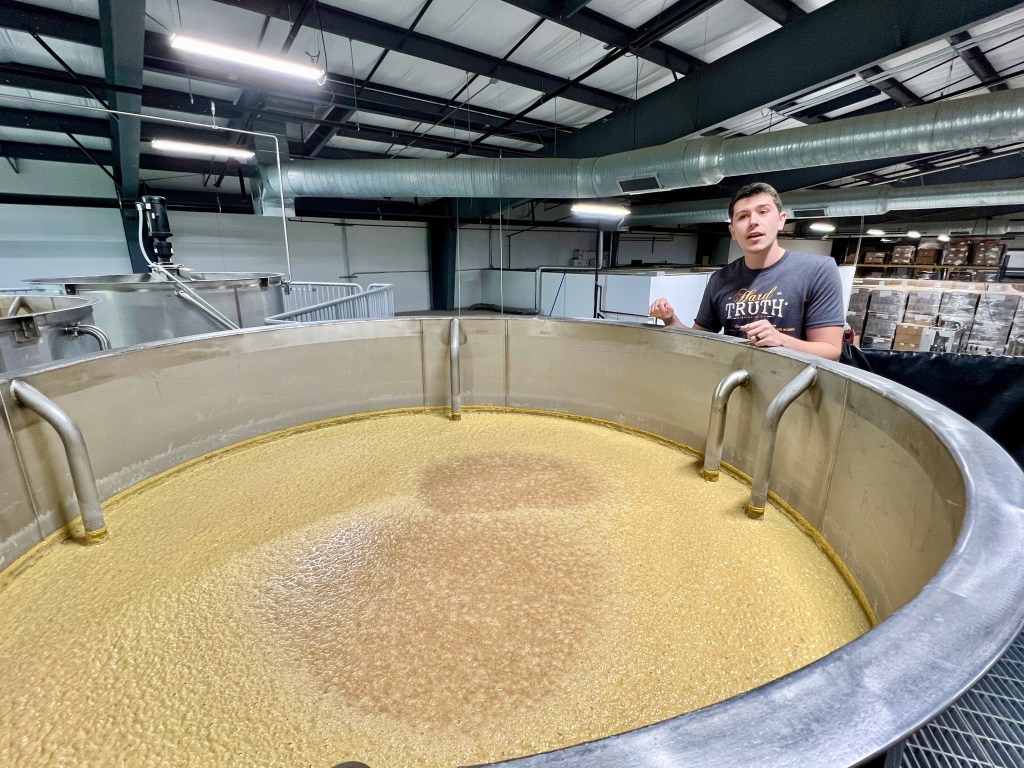
Mashing is the process of adding water to milled and/or malted grain, heating it, and activating enzymes in the grain to convert starches into fermentable sugars. All parts of this equation are important. You need a good water and that is typically considered water that is calcium-rich and iron-free. The temperature of the cooking process is critical because if too low or too high, the activation of the enzymes does not happen. When “just right” the mash becomes starchy and thick and looks a lot like oatmeal. Once cooled, it can be transferred to the fermentation stage.

Sour Mash versus Sweet Mash

Sour mash is a process in distillation that involves using material from an older batch to start fermenting a new batch of mash. It is very similar to the process of making sourdough bread with a starter. Using sour mash has the benefit of consistency between batches. It also reduces the possibility of unwanted bacterial growth.

Sweet mash is a process in distillation that does not use the sour mash as a starter for fermentation. Instead, only fresh yeast is used. Using sweet mash has the benefit of more control over specific ingredients and the ability to use lower temperatures for fermentation. However, it does require more maintenance and extreme cleanliness to avoid contamination.

FERMENTATION

The goal of fermentation is the creation of alcohol. The basic formula is:
Yeast + Sugar = Alcohol + Carbon Dioxide.

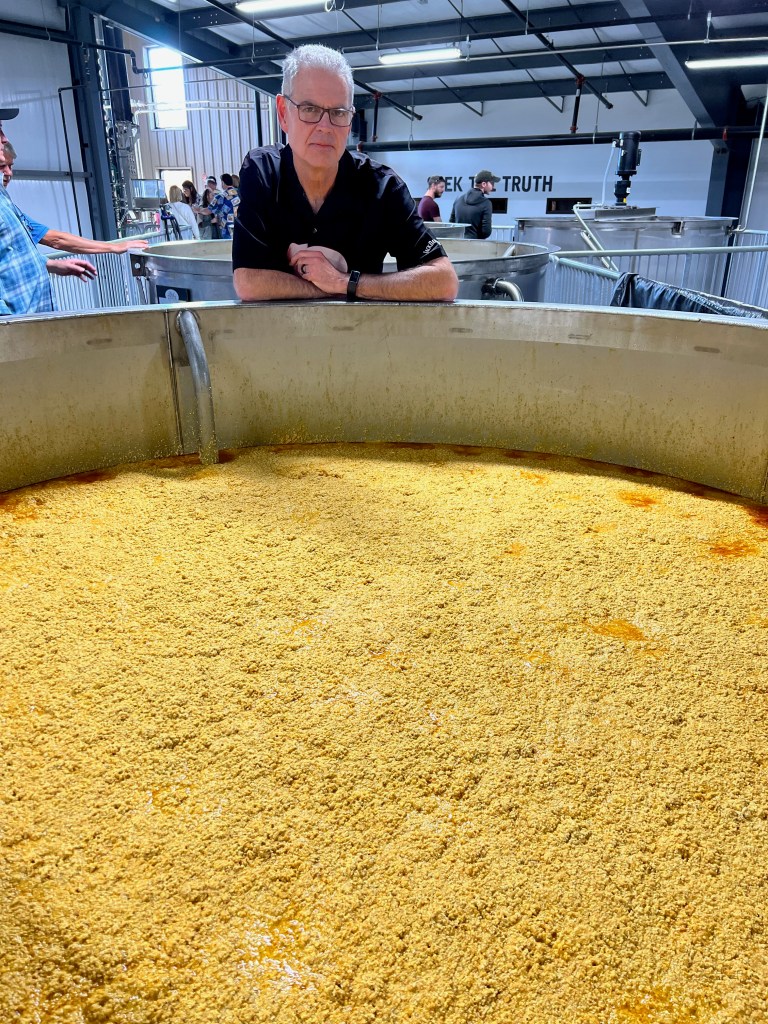
During the fermentation stage, yeast is added to the mash and it begins converting the sugars in the mash to alcohol and carbon dioxide. The fermentation stage typically requires three to five days but it could be longer as well. Ultimately, the product of fermentation is 8-18 percent alcohol by volume (ABV). The fermented mash is then ready for distillation.

SPIRIT DISTILLATION

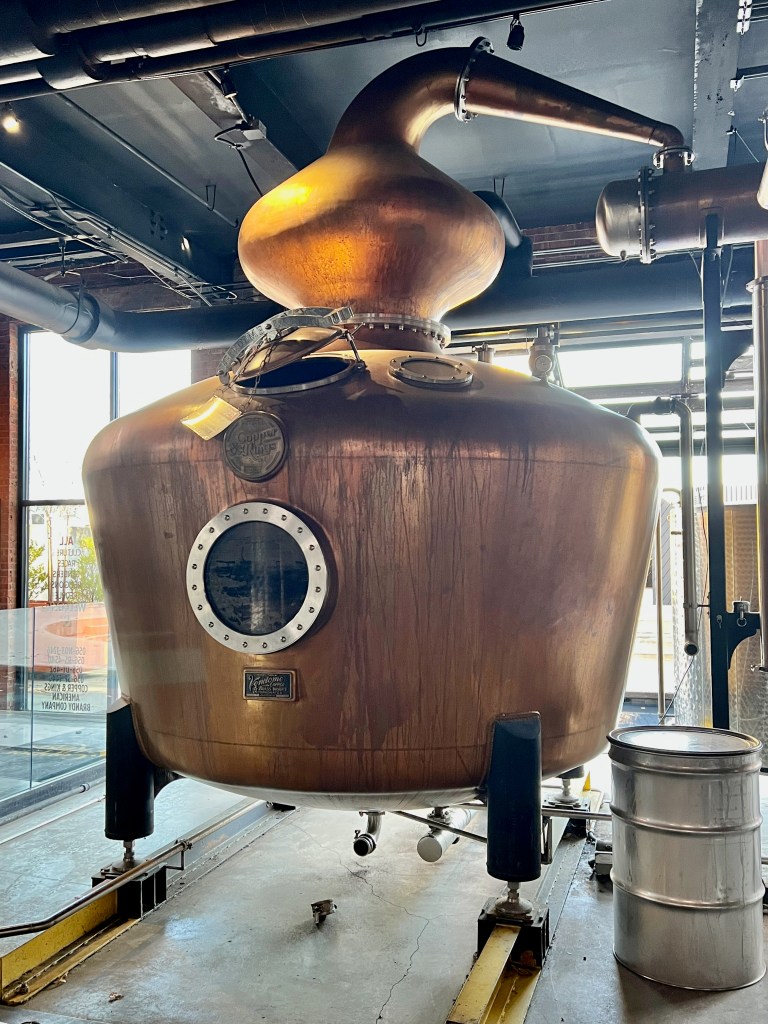
This is a Pot Still at Copper & Kings

In general, the purpose of distillation is to separate alcohol from water through evaporation and condensation. The fermented liquid is heated until the alcohol evaporates. The vapor is then cooled and condensed back into a liquid.  This process purifies and concentrates the alcohol.

In the spirits world, there are three primary classifications of stills in production:
1. Column stills provide a continuous process and are very efficient. This type of still is currently very common in the bourbon industry.
2. Pot stills are considered more traditional and are often used for smaller batches.  Some Distillers in the bourbon industry prefer a pot still because they appreciate the flexibility and control and believe they produce more flavorful spirits.
3. Hybrid stills, as the name implies, combine features of pot and column stills.

BARREL AGING

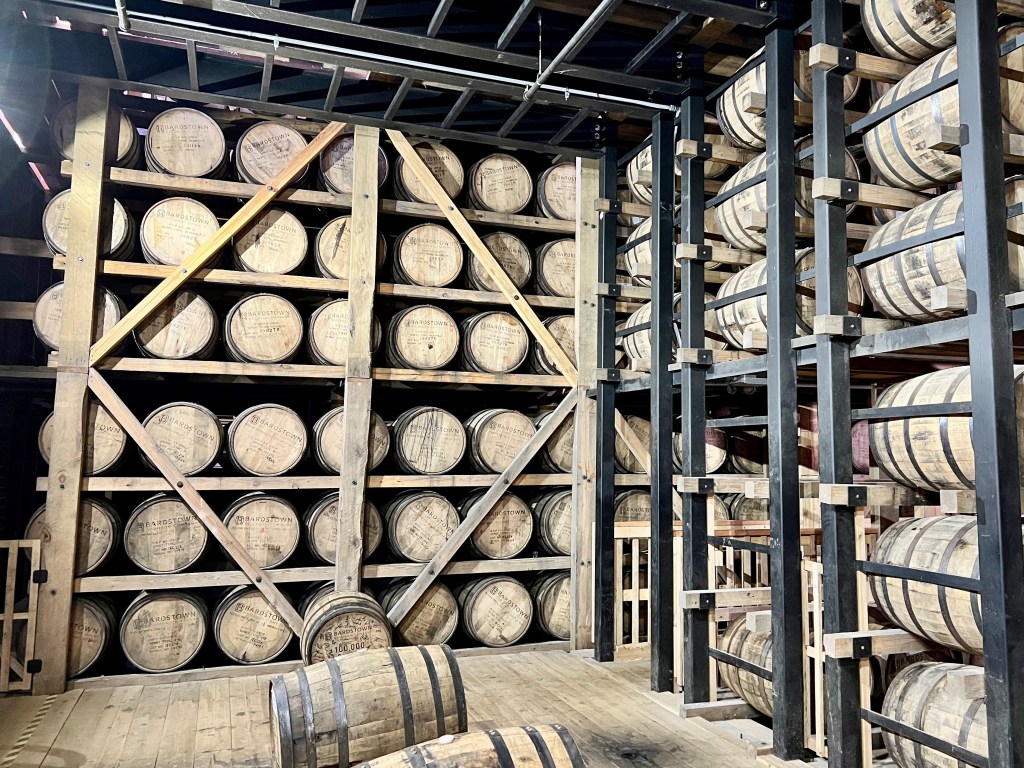
Barrel storage at Bardstown Bourbon Company

Barrel aging is an important step in the whiskey-making process. A transformation occurs when a clear spirit is placed into a barrel and interacts with the wood. As it evolves, the spirit gains color, aroma, flavor, and complexity. Whiskey could age in a barrel from two to twenty-five years.

For bourbon, a requirement is that it is stored in a new, charred oak barrel. The charring process opens the wood and prepares it to receive the spirit. Without being overly scientific, during a warm season, the liquid expands and is absorbed into the barrel. In a colder season, the liquid contracts and exits the wood while bringing the colors and flavors with it.

This relationship with the barrel creates the color we expect from bourbon.  Even more importantly, it brings forward flavors from the wood that interact with the flavor profile of the spirit. An amazing synergy occurs, and this is where the flavors of caramel, vanilla, toffee, butterscotch are derived. In addition, the char level of the barrel can contribute spice and smoke flavors.

Understanding when the spirit is “ready” or at its peak is an experience art form. Sometimes it is the Master Distiller that makes the determination. Some distilleries have specific roles such as Head of Maturation or Lead Taster. Other times there are routine samples drawn and explored by teams of people to narrow it down. It also depends on the specific requirements for labeling – does it need to be at least two years old, does it require at least four years, etc. A particular brand might have a very specific flavor profile that is being sought and it won’t be bottled until that is achieved.

I hope this very high-level overview of the process will bring you a greater appreciation of what is in that bottle that you enjoy so much and why there are so many nuances from brand to brand.

Cheers!


Blended Whiskey

02/25/24
By Rebecca Herman McBrayer

Whiskey (generic) must be made from cereal grains, distilled below 190 proof, placed into an oak container, and bottled at a minimum of 80 proof.

A Blended Whiskey is a mixture of different types of whiskeys, sometimes with other ingredients. It’s typically made by mixing one or more higher-quality straight or single malt whiskeys with less expensive spirits, neutral spirits, colorings, and flavorings. For example, a blended Scotch might be a combination of a barrel-aged malt whisky and some other grain whisky. 

In the US, blended whiskey is a combination of straight whiskies and neutral spirits containing at least 20 percent straight whiskey and bottled at not less than 80 proof.

History and Pioneer

The art of blending whisky was pioneered by Andrew Usher in Edinburgh, Scotland, in the early 1860’s. It was discovered that blending whisky could create a lighter and sweeter whisky than the more common robust whiskies of that time.

Benefits of Blending Whiskey

First, it allows the distiller to produce a consistent flavor. When we open a bottle of Buffalo Trace, Four Roses, or Woodford, for example, we expect it to taste like the last bottle or drink that we had. The environment of the barrel, weather, placement in the rickhouse, etc. can affect the taste of the spirit in each barrel. The blending process allows a careful matching to the brand’s expected taste.

Another benefit is that blending can highlight the best qualities of each barrel. By combining barrels with specific characteristics, a distiller can achieve a higher quality end-product by identifying and blending the best qualities of each one. This can create a synergy for the flavor profile that is often better than any of the individual parts.

Sometimes the goal of blending could be to create a new and diverse flavor profile. By blending spirits derived from different grains, ranges of age, various storage and aging processes could produce an end-product that has unique and desirable flavor profile.

Also, it is not uncommon for young distilleries to used sourced whiskey. Sometimes this is because they are awaiting the aging process of the whiskey that they have produced. By blending various sources and ages, they can create a unique offering to match the flavor profile what they anticipate for their brand.

In addition, there could be another purposeful approach for using sourced whiskey for blending. Bardstown Bourbon Company is known for their Discovery Series and each series represents a very specific blend of sourced spirits. It might be a blend of different grained whiskey, from different distilleries, from different states and process requirements, different ages, the possibilities are endless.