04/23/24
By Rebecca Herman McBrayer
Last July, following a fantastic two-day 2023 Bardstown Bourbon Collection Mint Julep Tour, Wayne and I stopped by the gift shop of the Four Roses bottling facility in Coxs Creek, KY because we heard they had released the Four Roses Ten Recipe Tasting Experience boxed set and wanted to get one to try at some point.
Wayne and I enjoy Four Roses and often have people ask, “What is your favorite recipe?” We really didn’t know because we haven’t purchased a single barrel bottle that we didn’t enjoy. This past weekend, we had the time to devote to this experience and it was very fascinating and sometimes surprising.
Selected for this Tasting
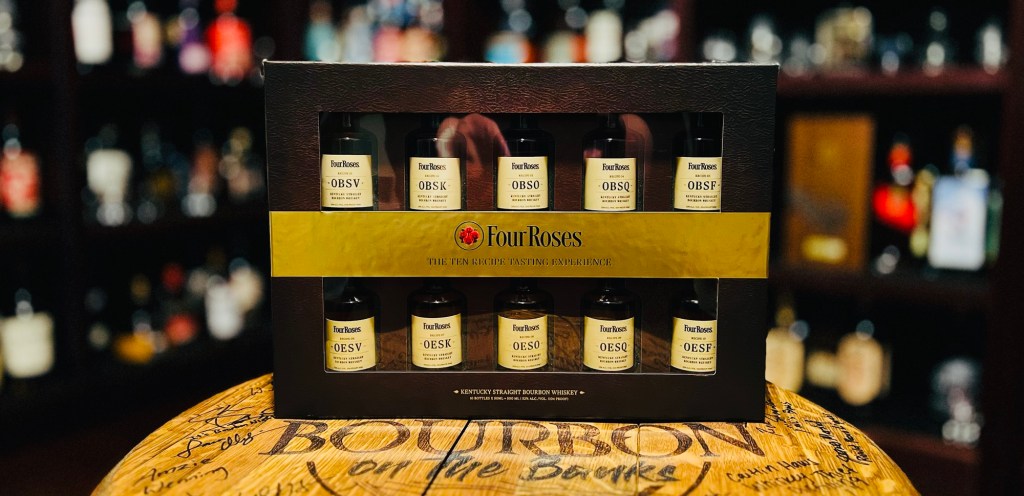
This tasting was boxed and ready for us – the Four Roses Ten Recipe Tasting Experience that is produced by Four Roses Distillery. The set includes ten 50 ml bottles, one of each recipe. The retail price at the gift shop for the set was $129.00
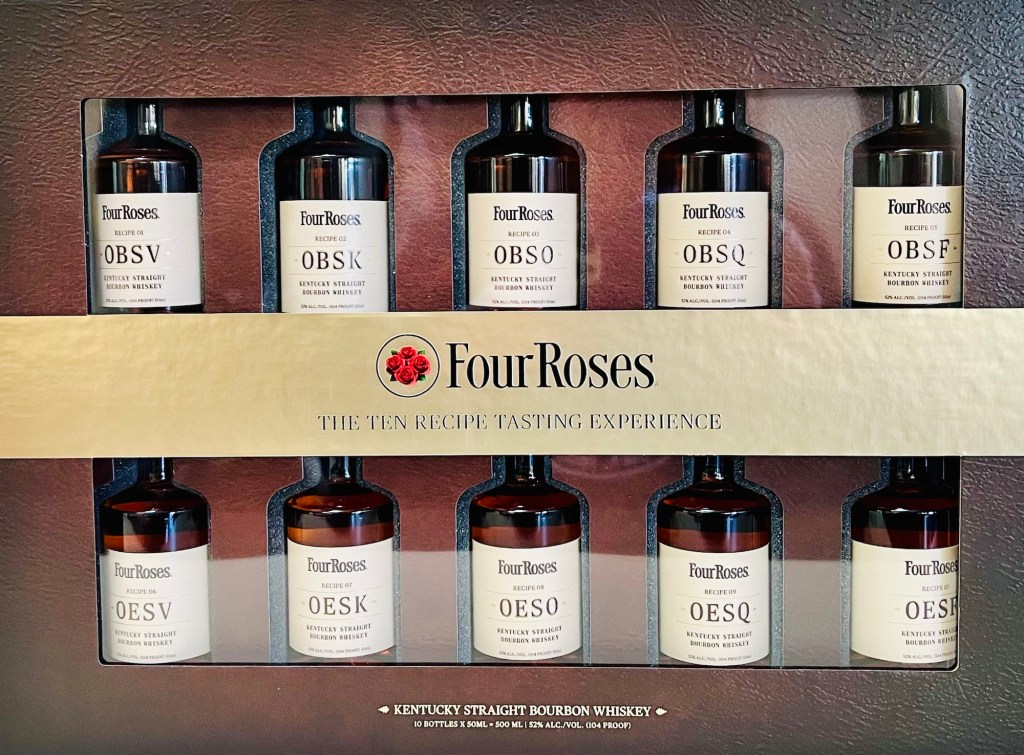
As discussed in Bourbon Yeast Flavors, Four Roses Bourbon produces a wide range of flavors by blending various yeast strains and mash bills. The use two mash bills – Mash Bill B emphasizes rye, while Mash Bill E prioritizes corn. Five yeast strains impart unique characteristics. These elements are combined to create ten distinct recipes as indicated on the table below.
| Mash Bill B – 60% Corn, 35% Rye, 5% Barley | Mash Bill E – 75% Corn, 20% Rye, 5% Barley | |
| Yeast V – delicate fruit | 1 – OBSV – delicate fruit and rye | 6 – OESV – delicate fruit and caramel |
| Yeast K – slight spice | 2 – OBSK – rye and baking spice | 7 – OESK – baking spice |
| Yeast O – rich fruit | 3 – OBSO – rich fruit | 8 – OESO – rich fruit and vanilla |
| Yeast Q – floral essence | 4 – OBSQ – rye and light floral character | 9 – OESQ – delicate grains and floral character |
| Yeast F – herbal notes | 9 – OBSF – delicate grains and floral character | 10 – OESF – light grain and mint |
Four Roses Mash Bill B

Mash Bill B – 60% Corn, 35% Rye, 5% Malted Barley
Age – at least 4 years (straight whiskey)
Proof – 104
We did the aroma individually, wrote down our notes, and then shared with one another. We did the same with the tasting portion. We also had the Four Roses recipe table. Our conversation and knowledge of the table certainly could have influenced our results.
Recipe 01 – OBSV:
***Aroma: Wayne – pear and chocolate; Rebecca – berries
***Taste: Wayne – honey and cinnamon; Rebecca – pear, herbal, and cinnamon
***Finish: Wayne – cinnamon; Rebecca – long baking spices
Recipe 02 – OBSK:
***Aroma: Wayne – honey and rye ; Rebecca – rye bread and baking spices
***Taste: Wayne – honey and rye; Rebecca – rye bread with honey butter on it
***Finish: Wayne – warm baking spices; Rebecca – light, warm cinnamon
Recipe 03 – OBSO:
***Aroma: Wayne – apple; Rebecca – plum and ripe apples
***Taste: Wayne – cinnamon; Rebecca – plum and fig
***Finish: Wayne – nutmeg; Rebecca – nutmeg with white pepper
Recipe 04 – OBSQ:
***Aroma: Wayne – honeysuckle and cinnamon; Rebecca – light cherry and rose
***Taste: Wayne – disappointed, didn’t like; Rebecca – honeysuckle and rye
***Finish: Wayne – NA; Rebecca – light white pepper
Recipe 05 – OBSF:
***Aroma: Wayne – honey, light fruit, and mint; Rebecca – rye, mint, and tea
***Taste: Wayne – tea, mint, and honey; Rebecca – mint tea and rye bread
***Finish: Wayne – light; Rebecca – cinnamon
Favorite Aromas: Wayne – OBSV and OBSK; Rebecca – OBSO and OBSV
Favorite Tastes: Wayne – OBSK and OBSO; Rebecca – OBSV and OBSK
Favorite Overall: Wayne – OBSK and OBSV; Rebecca – OBSV and OBSO
Four Roses Mash Bill E
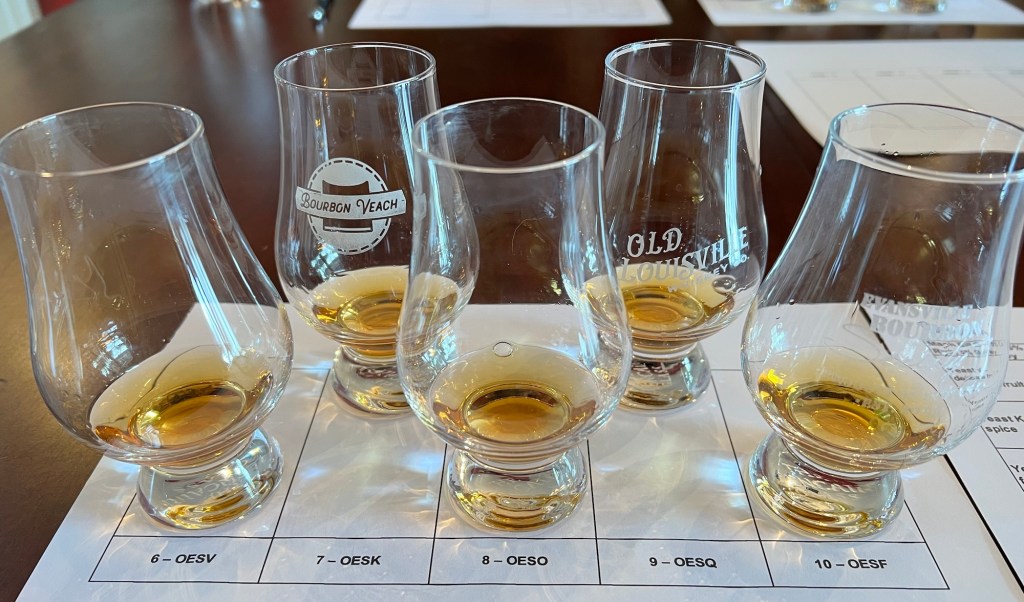
Mash Bill E – 75% Corn, 20% Rye, 5% Malted Barley
Age – at least 4 years (straight whiskey)
Proof – 104
The same as the other, we did the aroma individually, wrote down our notes, and then shared with one another. We did the same with the tasting portion. We also had the Four Roses recipe table. Our conversation and knowledge of the table certainly could have influenced our results.
Recipe 06 – OESV:
***Aroma: Wayne – vanilla, honey, baking spices; Rebecca – caramel, pear, baking spice
***Taste: Wayne – fruit and honey; Rebecca – caramel and pear
***Finish: Wayne – cinnamon; Rebecca – warm nutmeg and light pepper
Recipe 07 – OESK:
***Aroma: Wayne – honey, vanilla, baking spice; Rebecca – vanilla and allspice
***Taste: Wayne – honeysuckle and cinnamon; Rebecca – baking spices
***Finish: Wayne – cinnamon and pepper; Rebecca – light cinnamon
Recipe 08 – OESO:
***Aroma: Wayne – honeysuckle, vanilla, baking spice; Rebecca – vanilla cream and raspberry
***Taste: Wayne – spicy and honeysuckle; Rebecca – vanilla cream pie with berries on top
***Finish: Wayne – nutmeg and ginger; Rebecca – white pepper
Recipe 09 – OESQ:
***Aroma: Wayne – caramel, honey, vanilla; Rebecca – corn, lavender, and light spice
***Taste: Wayne – wild honey, nutmeg, cinnamon; Rebecca – buttered corn and lavender
***Finish: Wayne – nutmeg and cinnamon; Rebecca – nutmeg
Recipe 10 – OESF:
***Aroma: Wayne – rich vanilla, caramel, slight mint; Rebecca – herbal mint tea and baking spices
***Taste: Wayne – cinnamon and mint; Rebecca – sweet mint tea
***Finish: Wayne – cinnamon; Rebecca – nutmeg
Favorite Aromas: Wayne – OESK and OESF; Rebecca – OESV and OESO
Favorite Tastes: Wayne – OESK and OESV; Rebecca – OESO and OESV
Favorite Overall: Wayne – OESK and OESV; Rebecca – OESO and OESV
Blind Tasting Comparison

Note: The blind tasting was completed on Sunday, the day after the initial tasting.
This turned out to be much more challenging than we anticipated. It was our first blind tasting, and even so, we did break it into 5-pour sets based on Mash Bill B and Mash Bill E.
We started with the “B” group for aroma. This was a silent approach and we did not speak until we each had our top two. We then identified what was on the bottom of the glass but still did not know which one it was. Next we replicated the same approach for the “E” group. Finally, we took the top four that we had each selected and personally ranked them 1-4. Still, no idea which was which.
We repeated this exact process for the tasting component. This took much longer because we drank quite a bit of water between recipes to clear our palates.
Once we completed the process, we looked up the codes for each pour. We found it interesting that we each leaned more toward the Mash Bill B (higher rye) and that our taste tended to align more with one another than our nose. Below are our results.
| Aroma | Taste | |
| #1 of Mash Bill B | W: OBSK; R: OBSK *SAME* | W: OBSV; R: OBSV *SAME* |
| #2 of Mash Bill B | W: OBSF; R: OBSV | W: OBSQ; R: OBSK |
| #1 of Mash Bill E | W: OESV; R: OESQ | W: OESQ; R: OESK |
| #2 of Mash Bill E | W: OESF; R: OESK | W: OESV; R: OESQ |
| #1 Preference | W: OESV; R: OBSK | W: OBSV; R: OBSV *SAME* |
| #2 Preference | W: OBSK; R: OESQ | W: OBSQ; R: OBSK |
| #3 Preference | W: OBSF; R: OBSV | W: OESQ; R: OESQ *SAME* |
| #4 Preference | W: OESF; R: OESK | W: OESV; R: OESK |
We learned that information absolutely influences your palate. That could be what we have watched or read regarding other similar tastings, what the distiller states we might find, and even our ongoing conversation throughout a tasting as that makes it a shared versus individual experience.
Just for Fun – A Bit of Blending
Just for fun, we decided to try some blending. Except for single barrel offerings, most of the Four Roses expressions are expertly blended under the watchful palate of Brent Elliott, Master Distiller. We were curious to see what we might find by blending our top taste choices.
Wayne:
OBSV with OBSQ – Aroma of mint, cherry, baking spice; Taste of honey and cinnamon
OESQ with OESV – Aroma of honey and vanilla; Taste of honey, mint, and vanilla
All Four – Aroma of honey and vanilla; Taste of mint, rye, and cinnamon
Rebecca:
OBSV with OBSK – Aroma of berries, plum, rye, and mint; Taste of fruit, honey, plum, and finished with cinnamon and nutmeg
OESK with OESQ – Aroma of caramel, vanilla, berries, and tea; Taste of caramel, corn, vanilla cream, mint and finished with nutmeg and pepper
All Four – Aroma of rye bread, caramel, and fruitiness; Taste of caramel, vanilla, honey, fruit and finished with nutmeg
This was super fun to do some “blending” at home. It was interesting to see which characteristics had the strength to rise to the top over such a wide range of aromas and tastes happening. On a side note, we each took our remaining six recipes and poured them into a Glencairn to sip on throughout the day.
Discussion and Final Notes
As fans of Four Roses, we really enjoyed this challenge/experience. We now better understand their approach to bourbon and blending and this brought us a greater appreciation for the Small Batch and Small Batch Select (although they are typically 6-7 years old) expressions and helped us to better understand why we might prefer one single barrel over another.
Speaking of single barrels, these samples and tastes will likely never perfectly match a single barrel; although, there should be a family resemblance. A single barrel is selected for its specific characteristics. These samples are straight whiskey and likely in the four-year range. Single barrels are typically aged 7-9 years. An older single barrel should have additional barrel notes. Plus, if you purchase a store picked single barrel, that will have the characteristics of what that selection team desired.
Since we have one more set, we plan to do this again in 6-12 months; however, we will approach it differently to make it a new experience. Perhaps comparing yeast strain as the primary or head-to-head challenges in a bracket system. A bracket approach might be nice as we could do it over several days and avoid palate fatigue. We will let you know when that happens!
Meanwhile, enjoy Four Roses because surely there is a small batch or single barrel that aligns with your palate.
Cheers,
Rebecca
Photos by Rebecca Herman McBrayer
Kentucky Straight Bourbon Whiskey
Kentucky Straight Bourbon Whiskey:
Such whiskeys have all the requirements of bourbon: Made in the U.S, distilled at <= 160 proof, barreled at <= 125 proof, aged in new, charred oak containers, bottled at >= 80 proof.
Straight bourbon means it is aged at least 2 years (and must have an age statement if less than 4).
In addition, to be Kentucky Straight Bourbon, it has the additional requirement that it must be produced and aged at least 1 year in the state of Kentucky.
For additional information on bourbon requirements, please read this post – Bourbon Whiskey.
NOTE: The bourbon in this review was purchased by us. We were not compensated by the spirit producer for this review. This is simply our opinion based on what we tasted on this day. Please drink responsibly.

 Your Bourbon Journey