August 11, 2024
By Rebecca Herman McBrayer

It is hard to believe that this time last week Wayne and I had just returned from our amazing Louisville, Chocolate, and Bourbon – Oh My! weekend. Our typical trips to Louisville are event-driven. It might be a dinner, a specific distillery experience, or even a bottle release. Last weekend was different. The trip was focused on seeing a long-time friend who would be there for the weekend. It was about friendship, sharing our passion for bourbon, exploring new things, and reconnecting with great friends from afar as well as in the local area. While not on a “bottle hunt” we are always open when a situation presents itself.
The Michter’s Shenk’s and Bomberger’s are typically very challenging to acquire as so few are made each year. While in Louisville, we wanted to share The Bar at Michter’s with our friends. We walked into Michter’s at 4:30 PM on Friday afternoon and I noticed the combination package sitting on the counter. I inquired if they were for sale and the person said, yes, and they are the last ones we have today. Well, there you go. You just never know and it certainly doesn’t hurt to ask!
Shenk’s Homestead Sour Mash Whiskey is a limited edition release celebrating Kentucky’s whiskey-making heritage and part of Michter’s Legacy Series. Founded by John Shenk in 1753, the distillery became known as Michter’s in the 20th Century. This small-batch, full-bodied whiskey is made using traditional sour mash methods in Kentucky, with a significant amount of rye and aged in toasted French oak barrels from the Vosges region, imparting a unique finish and rich mouthfeel.
Bomberger’s Declaration Distillery Bourbon pays tribute to the former Bomberger’s distillery from the 1800s and later as Michter’s in the 20th Century. This 2023 release is a small batch 108 proof Kentucky Straight Bourbon Whiskey, continuing the tradition of offering a bold and beautiful 108 proof Kentucky Straight Bourbon. It features a rich and complex flavor due to aging a portion of the bourbon in Chinquapin oak. The oak was seasoned for three years, toasted, and charred to exact specifications. Malted rye was also used in the production of this bourbon.
Wayne and I were excited to taste these side-by-side. Please be sure to read our approach to Tasting Whiskey if you haven’t already.
Shenk’s Homestead Kentucky Sour Mash Whiskey by Michter’s
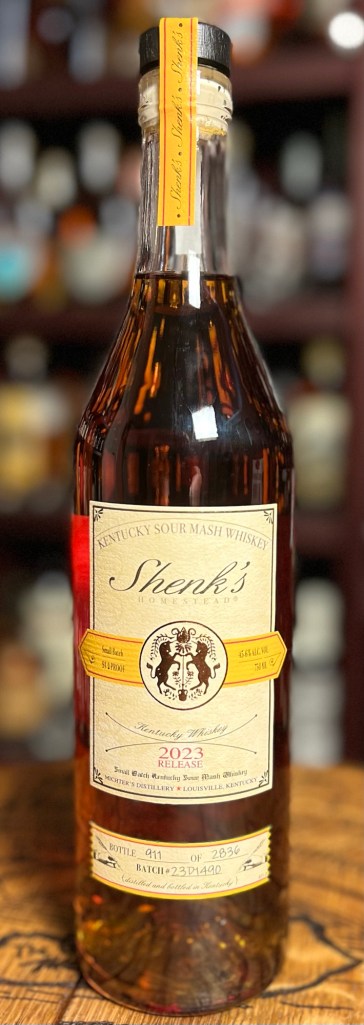
Mashbill – Undisclosed but with “significant” rye.
Age – NAS (at least 4 years)
Other – 2023 Release; Batch 23D1490; Bottle 911 of 2836
Proof – 91.2
Price Paid – $119 (plus tax)
Appearance – Dark amber.
Aroma – Toffee, vanilla, light butterscotch, spices, a hint of smoke.
Tasted Neat – Very smooth and creamy and different from what was experienced on the nose as it is less sweet and more savory. There is a coffee note with dark chocolate and burnt caramel. The wood from the barrel is present as is a smooth spiciness and a hint of honey.
Finish – Like the palate, the finish is smooth and savory with black pepper and baking chocolate.
Tasted with dried cranberry – The cranberry brightened the otherwise deep, dark notes of Shenk’s. There is additional spice and some zesty notes that were very refreshing, although a completely different experience.
Tasted with a pecan – As often happens, the pecan brought forward even more wood and dark notes. The chocolate is dark and inviting with a nice white pepper and oak finish.
Tasted with dark chocolate – This option brought the coffee forward with chocolate, caramel, and black pepper. It is incredibly creamy and with a nice finish as well.
Bomberger’s Declaration Kentucky Straight Bourbon Whiskey by Michter’s

Mashbill – Undisclosed but some malted rye was used
Age – NAS (at least 4 years)
Other – 2023 Release; Batch #23E1948; Bottle 427 of 2386
Proof – 108
Price Paid – $129 (plus tax)
Appearance – Rich mahogany
Aroma – A lot of wood influence with vanilla cream, burnt caramel, honeysuckle, stewed cherries, baking spices, and a hint of nuttiness.
Tasted Neat – First, there is a terrific mouthfeel that is creamy and truly coats the palate. Sweet notes of butterscotch, toffee, molasses, and cherries greet the palate. Cardamon, dark chocolate, graham crackers, and a hint of mint are welcoming mid-palate. As it reaches the back of the palate, the cinnamon, nutmeg, black pepper, and tobacco join the journey.
Finish – Medium to long finish with warm backing spices, coffee, oak, mint, and barrel char.
Tasted with dried cranberry – The cranberry really changed it to a tartness of lemon zest with a finish of white pepper.
Tasted with a pecan – Again, the pecan brought the wood forward and a strong cinnamon finish.
Tasted with dark chocolate – This was tasty and very creamy with coffee and chocolate followed by cinnamon and white pepper on the finish.
Discussion and Final Notes
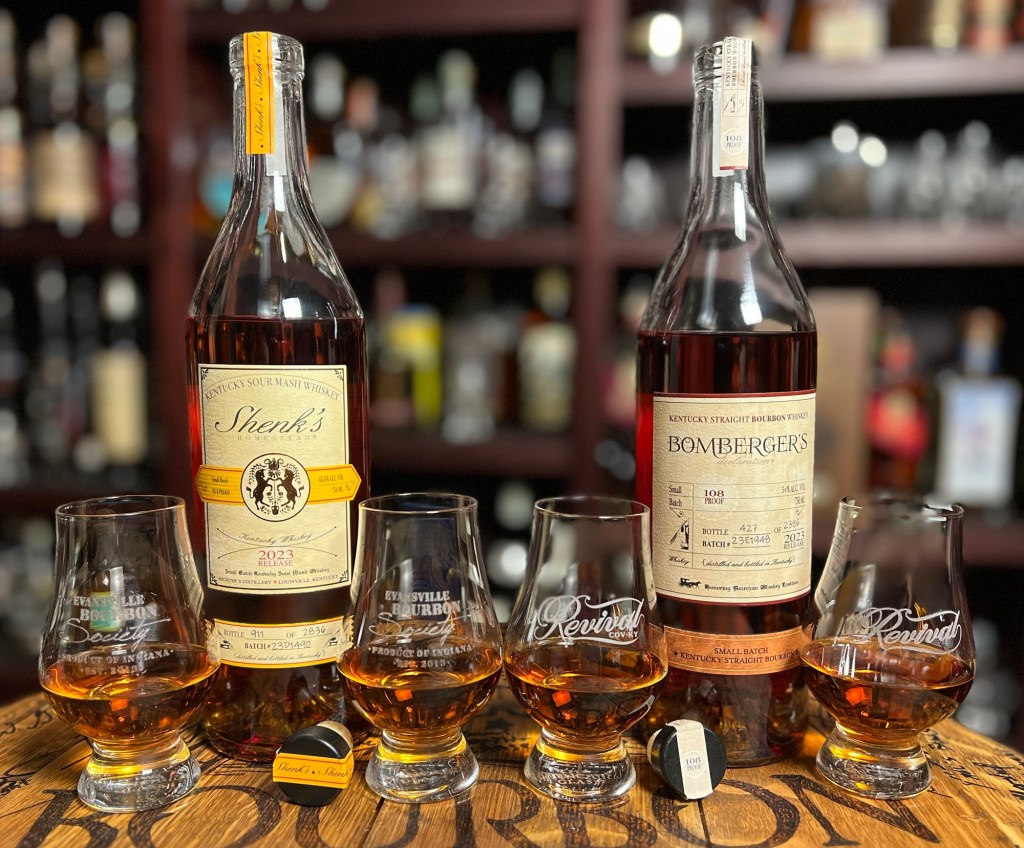
This is somewhat difficult to select which we enjoyed the most as each has something special to offer.
The Shenk’s Homestead 2023 Release boasts a dark amber color and offers a delightful tasting experience. Aromas of toffee, vanilla, light butterscotch, and a hint of smoke lead to a smooth and creamy texture with rich notes of coffee, dark chocolate, burnt caramel, and a velvety spiciness. The finish is smooth and savory, with hints of black pepper and baking chocolate.
The Bomberger’s Declaration 2023 Release has a mahogany color and offers a rich tasting experience with aromas of wood, vanilla cream, burnt caramel, honeysuckle, cherries, baking spices, and a subtle nuttiness. The palate is coated with creamy sweetness and welcomes notes of butterscotch, toffee, molasses, and cherries, as well as hints of cardamom, dark chocolate, graham crackers, and mint. The finish is marked by warm baking spices, coffee, oak, mint, and barrel char.
As always, it all comes down to your personal taste preferences and what resonates with you on any given day. When it comes to Shenk’s and Bomberger’s, the experience is truly remarkable. However, the depth and consistency of Bomberger’s simply resonates with us on a whole other level. From the captivating nose to the lingering finish, every sip is a journey. Being bourbon enthusiasts, Bomberger’s exquisitely crafted flavors nudge it ahead in our book. That being said, we wholeheartedly recommend trying both, and eagerly anticipate the opportunity to savor future releases.
Cheers,
Rebecca & Wayne
Photos by Rebecca Herman McBrayer
Kentucky Straight Bourbon Whiskey Spirit Requirements
Sour mash is a process in distillation that involves using material from an older batch to start fermenting a new batch of mash. It is very similar to the process of making sourdough bread with a starter. Using sour mash has the benefit of consistency between batches. It also reduces the possibility of unwanted bacterial growth. For additional information on bourbon requirements, please read this post – Four Stages of Making Spirits.
Bourbon Whiskey: Made in the U.S, distilled at <= 160 proof, barreled at <= 125 proof, aged in new, charred oak containers, bottled at >= 80 proof. Straight bourbon means it is aged at least 2 years (and must have an age statement if less than 4). In addition, to be Kentucky Straight Bourbon, it has the additional requirement that it must be produced and aged at least 1 year in the state of Kentucky. For additional information on bourbon requirements, please read this post – Bourbon Whiskey.
NOTE: The whiskeys in this review were purchased by us. We were not compensated by the spirit producers for this review. This is simply our opinion based on what we tasted on this day. Please drink responsibly.

 Your Bourbon Journey